Address
304 North Cardinal
St. Dorchester Center, MA 02124
Work Hours
Monday to Friday: 7AM - 7PM
Weekend: 10AM - 5PM
Address
304 North Cardinal
St. Dorchester Center, MA 02124
Work Hours
Monday to Friday: 7AM - 7PM
Weekend: 10AM - 5PM
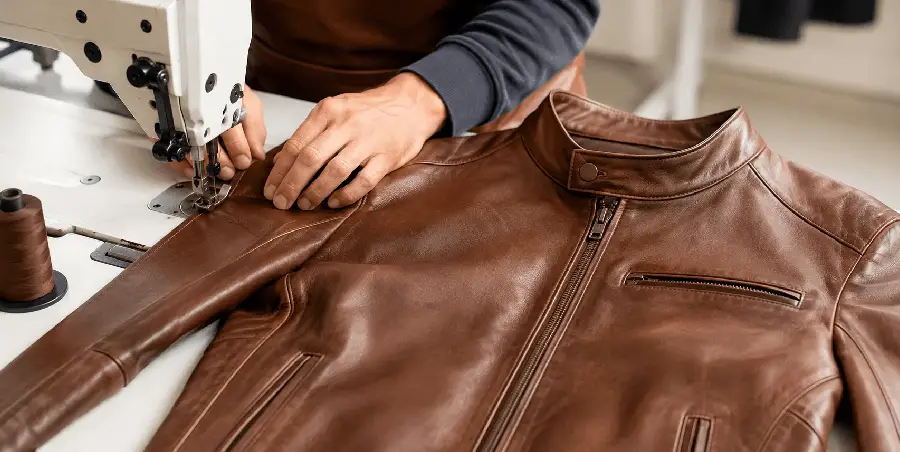
How is a leather jacket made? Most guides to leather jacket manufacturing are written from the outside — a marketing team describing a process they’ve never stood inside. This one is different. Every stage below is documented directly from an active production line, in the order it actually happens: design, materials, pattern, cutting, stitching, quality control, customer approval, bulk production, packing, and shipping.
Once you understand how a leather jacket is made from start to finish, you know exactly what questions to ask before placing an order. A leather jacket that fits well, holds its stitching, and arrives on time isn’t the result of one skilled machinist. It’s the result of ten connected stages, each with its own tolerances and checkpoints. When any one stage is rushed or skipped, the failure shows up later — in a jacket that ships with uneven panels, a batch that arrives in the wrong sizing ratio, or a shipment that misses its delivery window.
Understanding the full process gives you, as a buyer, a clear framework for evaluating any manufacturing partner: what to ask for at each stage, and what a properly documented production run should look like from first sketch to final delivery.
Here is how a leather jacket is made, broken down into the ten stages every properly run production line follows.
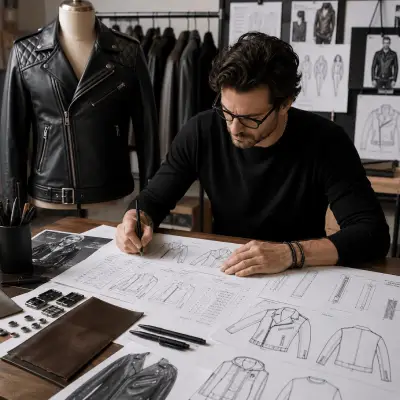
Every jacket begins as a tech pack — a detailed technical document specifying every measurement, seam type, hardware position, and construction detail for the garment. This is the blueprint the entire production line will build from.
A complete tech pack includes:
If your manufacturer skips this stage and moves straight to sampling from a verbal brief, that’s a warning sign. A missing or incomplete tech pack is the single most common cause of fit inconsistency across a production run.
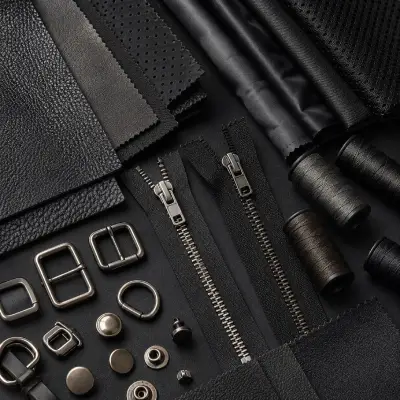
Once the tech pack is locked, every material on it is sourced and laid out for approval — leather, lining fabric, thread, zippers, snaps, D-rings, and buckles. Nothing enters production until the buyer has approved physical swatches, not just photos.
Leather choice affects everything downstream:
“See our full guide on leather types.”
Hardware quality matters just as much as the leather. A zipper that fails after twenty uses will define a buyer’s experience of the whole jacket, regardless of how good the leather is. This is why hardware is matched and approved against spec at this stage, not left until final assembly.
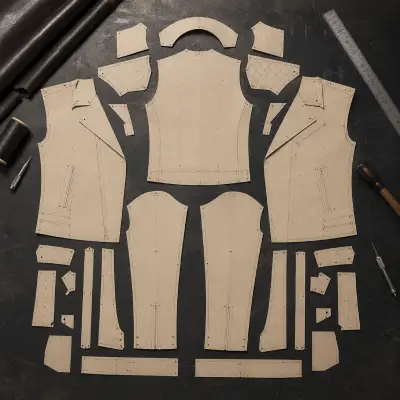
The tech pack’s flat sketches are converted into hard patterns — one physical template for every panel of the jacket: front, back, sleeves, collar, pocket facings, and lining pieces.
This is where fit is actually built. A pattern maker accounts for how leather behaves differently from woven fabric — it doesn’t stretch the same way on the bias, and panel placement has to work with the natural grain and thickness variation across a hide. Getting this stage wrong is the most common reason two jackets from the same ‘design’ fit differently.
Patterns are graded across the full size range before a single piece of leather is cut, so that a size Medium and a size XXL keep the same proportions, not just a scaled-up measurement.
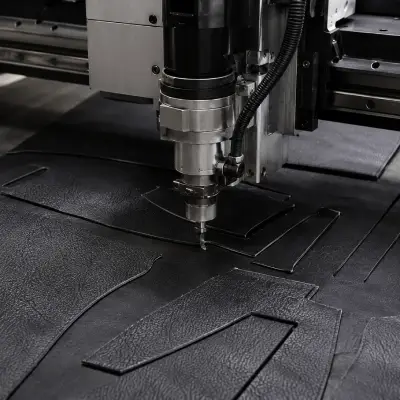
With patterns approved, cutting begins — typically with CNC or die-cutting equipment for consistency across bulk volume, alongside hand-cutting for panels that require closer control near natural hide markings.
A hide is never uniform. Shoulder sections are thicker and more rigid; belly areas are thinner and stretch more. A properly run cutting stage places front panels and structural pieces on the denser sections of the hide and reserves softer areas for sleeve linings or areas needing more flexibility. Cutting pieces wherever they happen to fit on the hide — a common shortcut in lower-cost production — is what causes sleeves that drape differently from each other or panels that age unevenly.
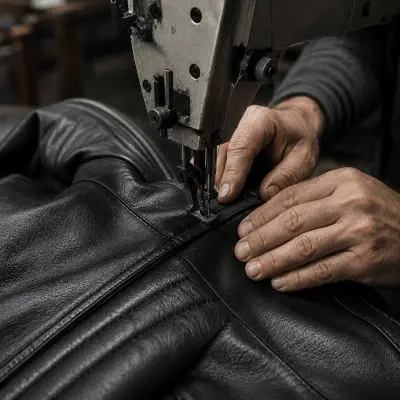
Cut panels move to assembly, where they’re joined on industrial machines built specifically for leather — heavier gauge needles, adjusted tension, and reinforced stitching at stress points (shoulder seams, pocket corners, zipper tape).
This stage follows the tech pack’s seam specification exactly: stitch density, seam allowance, and reinforcement pattern are not left to the operator’s judgment. Zippers, snaps, and lining are installed in a fixed sequence so that every unit in the run is assembled identically, whether it’s unit one or unit one thousand.
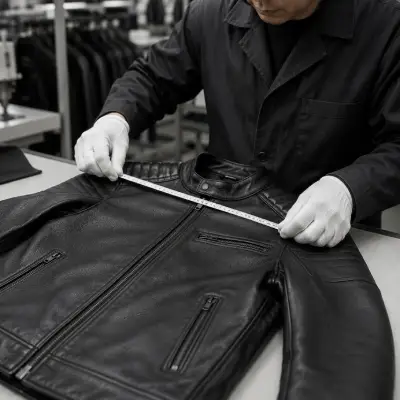
Before any jacket moves toward packing, it passes an inspection stage — typically an AQL-based check (Acceptable Quality Limit), the standard buyers should expect from any serious manufacturer. Common AQL thresholds are 2.5 for general production and a tighter 1.5 for premium or branded runs.
Inspectors check against three defect categories:
Every jacket is also measured directly against the tech pack’s spec sheet — chest width, sleeve length, body length — not just checked visually. Anything outside tolerance is pulled before it reaches packing.
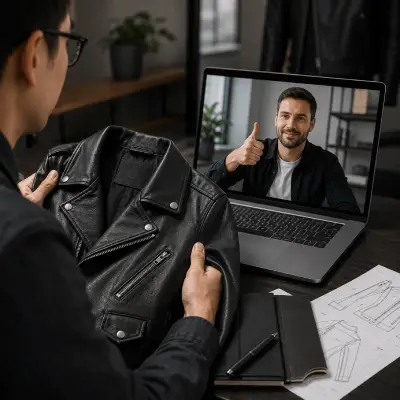
Before bulk production begins, a pre-production sample is sent for the buyer’s direct sign-off — reviewed live over video call where every detail can be checked in real time: stitching, hardware finish, lining, proportions, and overall hand-feel. This step exists to catch anything the buyer wants adjusted before hundreds or thousands of units are cut. Skipping it — moving straight from a photo approval to bulk production — is one of the most common (and costly) shortcuts in the industry.
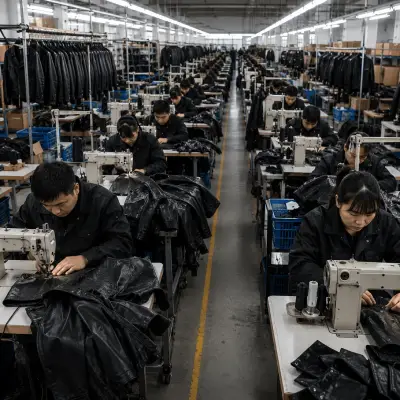
With the sample approved, the full order moves to the production floor. Multiple stitching lines run in parallel, each following the same approved tech pack, pattern grading, and stitch specification used for the sample — so a buyer receiving 2,000 units should see the same consistency as the one approved sample.
This is also where sizing ratios matter. A buyer’s size breakdown (how many Small, Medium, Large, etc.) is planned and tracked from the start of bulk cutting, not adjusted after the fact — because leather yield per size is calculated at the cutting stage, not the packing stage.
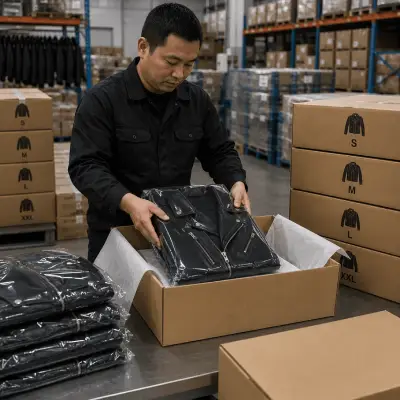
Finished jackets are steamed or pressed to remove any creasing from production, then individually packed — typically in a protective poly sleeve with tissue paper, boxed by size, and labeled clearly on the outside of each carton. Packaging specifications (poly bag vs. garment bag, branded hangtag placement, carton labeling format) are confirmed with the buyer ahead of this stage, since this is often the buyer’s first physical brand touchpoint with their own customer.
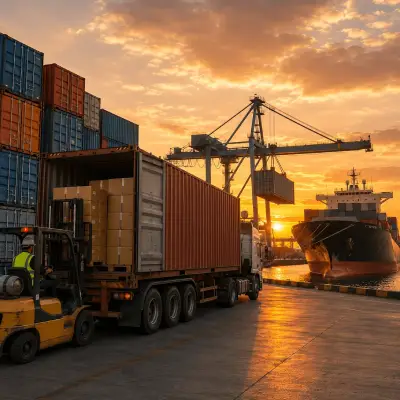
The final stage is export — cartons are palletized, loaded, and dispatched by the agreed freight method (air or sea), with documentation prepared for customs clearance at the destination market.
For buyers in the USA, Canada, UK, EU, and Australia, this stage should also include clear Incoterms (who is responsible for freight, insurance, and duties at each point), and full shipment documentation — commercial invoice, packing list, and bill of lading — provided without needing to be chased.
A jacket that goes through all ten stages properly — accurate tech pack, approved materials, precise pattern and cutting, reinforced stitching, AQL-based inspection, and a genuine pre-production approval step — is a jacket built to perform consistently across an entire order, not just in a single sample.
When evaluating a manufacturing partner, the questions worth asking are simple: Can they show you a tech pack for a past order? Do they inspect against a stated AQL standard? Will they send a sample for approval before bulk production starts? A manufacturer confident in their process will answer all three without hesitation.
A typical production cycle runs 8 to 14 weeks from an approved pre-production sample, depending on order volume, hardware complexity, and size range. Custom OEM programs requiring full pattern development from scratch generally sit at the longer end of that range.
Private label uses an existing, proven pattern with your branding applied — faster to market, lower development cost. OEM builds a fully custom garment from your own tech pack and design — more control, longer development timeline.
At minimum, AQL 2.5 inspection on finished goods, with a documented defect classification (critical, major, minor) and pre-shipment photos for buyer sign-off before cartons are sealed.
Yes — and you should insist on it. A pre-production sample approval step is a standard part of a properly run process, not an optional extra.
A leather jacket is made across ten connected stages — tech pack and design, material selection, pattern making, cutting, stitching, quality checking, customer approval, bulk production, packing, and shipping. Each stage has its own tolerances, and skipping any one of them is what causes inconsistency across a production run.