Address
304 North Cardinal
St. Dorchester Center, MA 02124
Work Hours
Monday to Friday: 7AM - 7PM
Weekend: 10AM - 5PM
Address
304 North Cardinal
St. Dorchester Center, MA 02124
Work Hours
Monday to Friday: 7AM - 7PM
Weekend: 10AM - 5PM

Selecting a leather duffel bag is simple, but selecting one that will still look good after five years is more challenging. The difference is in a few details that most buyers overlook and a maintenance routine that most owners don’t bother with until the bag has already aged poorly.
This guide covers everything from the elements that distinguish a quality leather duffel bag from an inferior one, how leather duffel bags compare to canvas and nylon, the price range you should expect, and the maintenance the bag deserves.
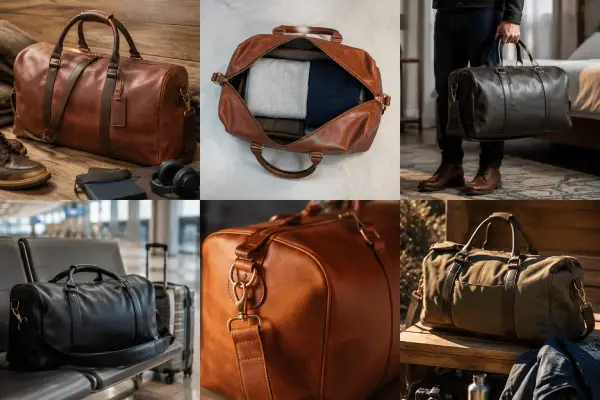
Start with leather grade, not color.

Every duffel bag on the leather duffel bag market falls into one of four leather grades. After price, leather grade is the most important thing to evaluate.
Full-grain leather duffel bags are the highest grade of leather duffel bags. Full-grain leather bags are made with entire animal hides, including the protective outer layer and natural grain. Because nothing is sanded or buffed away, these bags develop a patina as they age instead of simply wearing out like inferior bags. Full-grain bags are the toughest and most water resistant of the four grades.
Top-grain leather has its outer layer sanded and is covered with a protective layer that evens the surface. Because of this, it has a more uniform surface, but it won’t develop the same character with age. Additionally, the sanding removes a level of strength from the leather.
Genuine leather is a marketing term that has very little to do with grading systems. It simply indicates that animal hide is part of the construction, which can range anywhere from low-quality split layers to bonded leather. Instead of assuming genuine leather is high quality, know that it can be a low-quality leather construction.
PU leather actually is not leather at all. It’s a synthetic material made to look like leather. Modern PU leather has improved significantly and is a viable option for people wishing to have the leather aesthetic without the cost. It’s also important to know that this material won’t age like real leather; real leather wears in, while PU leather wears out.
Choose a size based on actual intended use rather than imagined use.
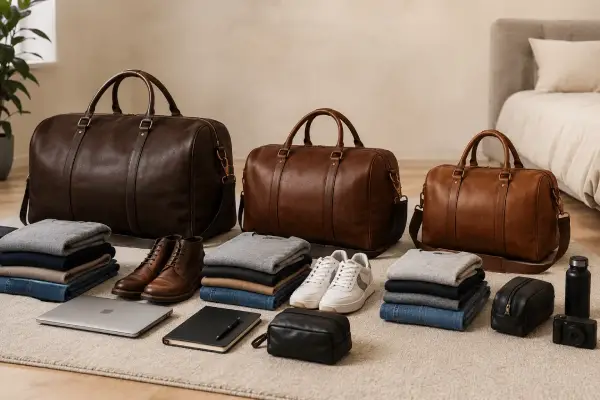
This is where first-time buyers especially make mistakes. Generally, a bag bought for “everything” ends up too large for frequent use and gets left in the closet.
For trips to the gym or day trips, bag sizes in the 30 to 35 liter range are a good target. Large enough to fit a full change of clothes, but small enough to carry comfortably without banging into your leg while you walk.
A bag in the 40 to 50 liter range is best for two to three day trips. This size gives plenty of space for your essentials and a pair of shoes without needing a herculean effort to close it.
A bag this size can work as carry-on luggage, but that can only be confirmed after checking the size restrictions of your preferred airline. Most airlines limit bags to 45 linear inches (length plus height plus width), and a bag around 22 inches long is typically permissible for most domestic flights. Because airline restrictions vary, it’s worth verifying rather than assuming.
Don’t only look at the leather. Check the hardware and stitching.
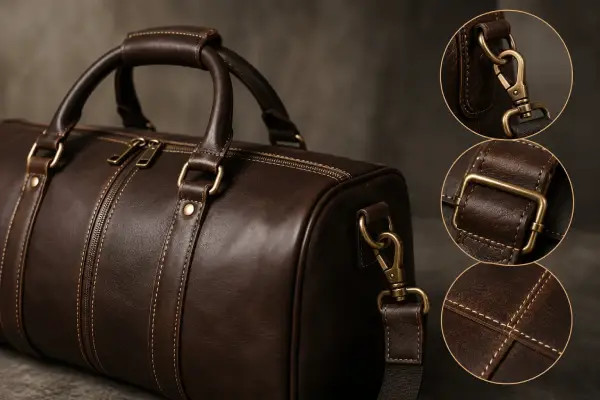
A bag is only as strong as its weakest stitching. Zippers should operate smoothly, and metal hardware and stitching (especially at the ends of a strap) should feel solid and stress resistant. Stitching at connecting points is typically the first to fail, so check for quality there first.
Several other signs point to good craftsmanship. A good bag should be able to sit up on its own without slumping or collapsing, which means a proper base panel or frame is built in underneath the leather, rather than just soft material folded into shape. The interior lining should show no glue residue and have its threads sewn in cleanly. The leather should flex when a corner is bent; leather that’s stiff with no flexibility when purchased is not likely to soften with use.
The most common mistake:
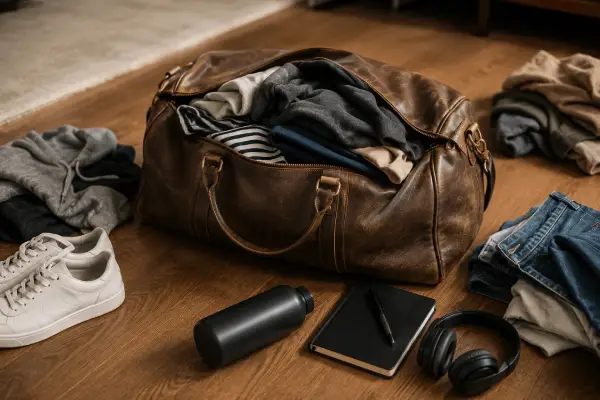
Letting the look of the bag override a material check. A bag with good full-grain leather can look identical to a bag with bonded leather. If a purchase is being made online, the grade of leather should be specifically stated. If a manufacturer or supplier isn’t willing to provide the grade, the bag shouldn’t be purchased.
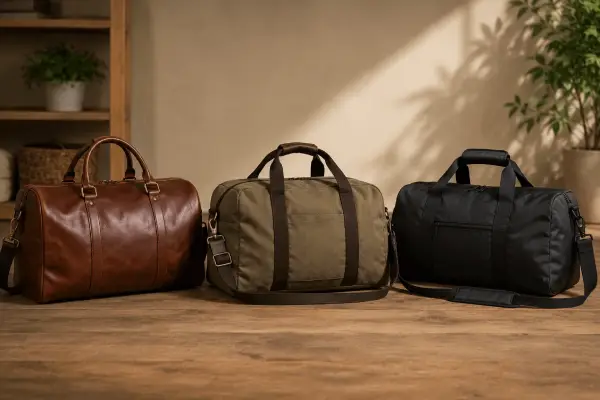
Leather isn’t always the ideal choice for every buyer, and the trade-offs are worth considering.
Canvas duffel bags are less expensive, and since they dry faster than leather, they’re better suited for the gym and camping. They’re more convenient for casual travel, since they’re less likely to trap water the way leather bags can, and can be tossed in a trunk without worrying about water damage. Leather develops character over time; canvas bags don’t. Typically the stitching and hardware deteriorate first on a canvas bag, and those are easier to replace than the material itself.
Nylon duffels are the lightest and most weather-resistant option. They’re convenient for frequent travelers, especially by air, who are trying to avoid excess baggage fees. They’re also the least durable of the three, since zippers and seams tend to break down faster than on leather.
Leather bags are the heaviest and most expensive option, but they genuinely last for decades and are the only one of the three that looks better as it ages. For a one-time purchase meant to last a decade or more, leather is usually the better long-term value over cheaper options that need to be replaced repeatedly.

Price is one of the more reliable signals of leather grade, since full-grain leather costs significantly more to source and work with than lower grades.
Bags made with full-grain leather and solid hardware tend to sit at the higher end of the price range, and can run considerably higher depending on craftsmanship and brand. Bags made with top-grain leather are usually priced lower while looking nearly identical to full-grain at a glance.
Genuine leather bags tend to be the most affordable real-leather option, and PU leather duffels are typically the least expensive overall. Both can be reasonable choices, depending on your budget and how long you expect to keep the bag. Be cautious of a bag priced like full-grain leather that doesn’t specify its actual grade; that mismatch is one of the more common ways buyers end up with regret after the purchase.

Leather requires a different touch than fabric and is more sensitive to cleaning. Because leather is porous, it can absorb whatever cleaning product is applied, which makes some stains harder to remove.
1. Remove everything from the bag’s main compartment and all smaller pockets.
2. Dust the surface with a soft, dry cloth before applying any cleaning solution, especially anything liquid.
3. Use a clean cloth dampened with mild leather cleaner, or gentle soap and water if no leather cleaner is available. The cloth should be damp, not wet.
4. Clean the surface using gentle, circular motions, concentrating on the handles and corners.
5. Polish metal hardware separately with a cotton swab and metal polish, keeping the polish away from the surrounding leather.
6. Dry the surface with a dry cloth, then let the bag air-dry away from sun and heating vents. Never use a hair dryer or other heat source on leather; it dries the leather out and can cause cracking.

This step is usually the one owners skip, but conditioning is essential to a leather bag’s longevity. Regular conditioning can meaningfully extend how long a bag lasts.
Regular use and exposure to air cause leather to lose its natural oils and dry out over time. Conditioning replaces those oils and keeps the leather flexible.
Leather conditioner should rarely be applied directly to the bag. Instead, apply a small amount to a clean, soft cloth and work it evenly into the leather. Let it absorb for 10 to 15 minutes before buffing off any excess with a dry cloth.
Condition a regularly used bag every season or so; condition a rarely used bag even less often. The biggest mistake here is over-conditioning. Conditioning too often makes leather less breathable, causes it to accumulate more dirt, and can leave it with a mottled appearance. With leather conditioner, less is more.
Conditioners can react differently with different leathers, and some can darken the surface. Always test on a small, hidden area first, so any unwanted reaction shows up before it affects the whole bag.
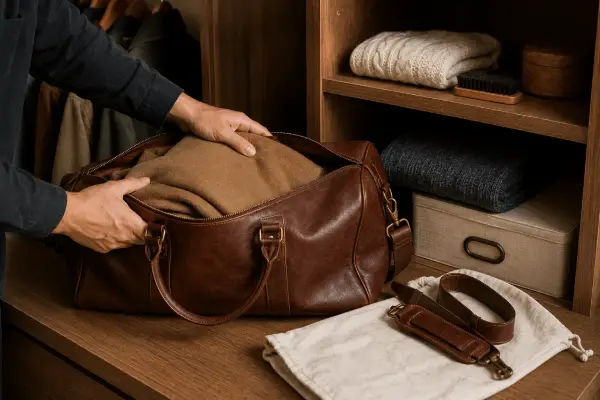
Conditioning a leather bag is important. How you store it when it’s not traveling matters just as much.
Leaving items inside a bag during long-term storage creates uneven pressure that can deform its shape over time.
Rolling is better than sharp folding for keeping the leather’s surface even. Sharp folds become permanent crease lines, the same way repeatedly folding a piece of paper along one line wears a crease into it.
Where possible, keep bags standing upright on dedicated shelf space, inside a breathable dust bag rather than plastic. Plastic traps moisture, and trapped moisture allows mold and mildew to grow on leather. Keep stored bags away from direct sunlight and heat sources, both of which cause discoloration and drying.
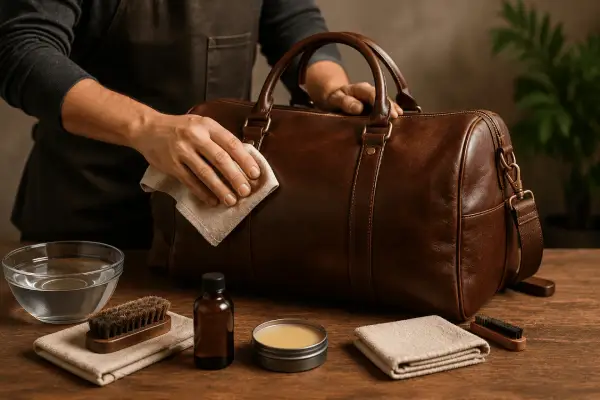
Treat any stain on a leather duffel bag as soon as you notice it. Leather absorbs liquids quickly, and a stain that’s had time to set becomes much harder to treat.
For common stains like light grease marks and dirt, the cleaning method above will work. Organic stains, including food and ink, are often better removed using a dry method rather than a wet one: cover the stained area with a light dusting of cornstarch or talcum powder, leave it for a few hours, then brush the powder away. If the stain remains, avoid experimenting with household products that could damage the leather further, and take the bag to a leather specialist instead.

No. Manufacturers and retailers use “duffel” and “duffle” interchangeably. The term traces back to a town in Belgium called Duffel, where the fabric used in early duffel bags was originally made. Neither spelling is more “correct” than the other.
A full-grain leather duffel bag can last decades with normal use and proper, regular cleaning and conditioning. Lower grades of leather and synthetic alternatives generally last only a few years of frequent travel, and how quickly wear shows up depends on how often the bag travels.
Generally, it’s best to avoid it. Full-grain leather has better moisture resistance than other grades, but getting the bag wet can still cause staining and stiffening. If it happens, blot the moisture out rather than letting the bag air-dry on its own.
Clean it with a cloth that’s damp, not soaked, using a leather-safe cleaning product, and dry it fully afterward. Avoid products with excessive moisture, and balm the leather regularly to prevent cracking.
Empty the bag completely and pack the interior with acid-free tissue paper or a soft cloth to help it hold its shape. Store it in a breathable dust bag, away from direct heat sources and sunlight.
Yes. “Duffel” and “duffle” refer to the same style of travel bag, and both spellings are used interchangeably by manufacturers and retailers across the industry.

With the right care, a quality leather duffel bag can last a lifetime, which is part of why good leather commands a higher price. Bonded leather, by contrast, can never become full-grain leather no matter how much care and treatment it receives.
If you’re starting your own leather duffel bag business rather than buying a single bag for personal use, the same material and construction questions above are worth asking a manufacturer before committing to an order.