Address
304 North Cardinal
St. Dorchester Center, MA 02124
Work Hours
Monday to Friday: 7AM - 7PM
Weekend: 10AM - 5PM
Address
304 North Cardinal
St. Dorchester Center, MA 02124
Work Hours
Monday to Friday: 7AM - 7PM
Weekend: 10AM - 5PM
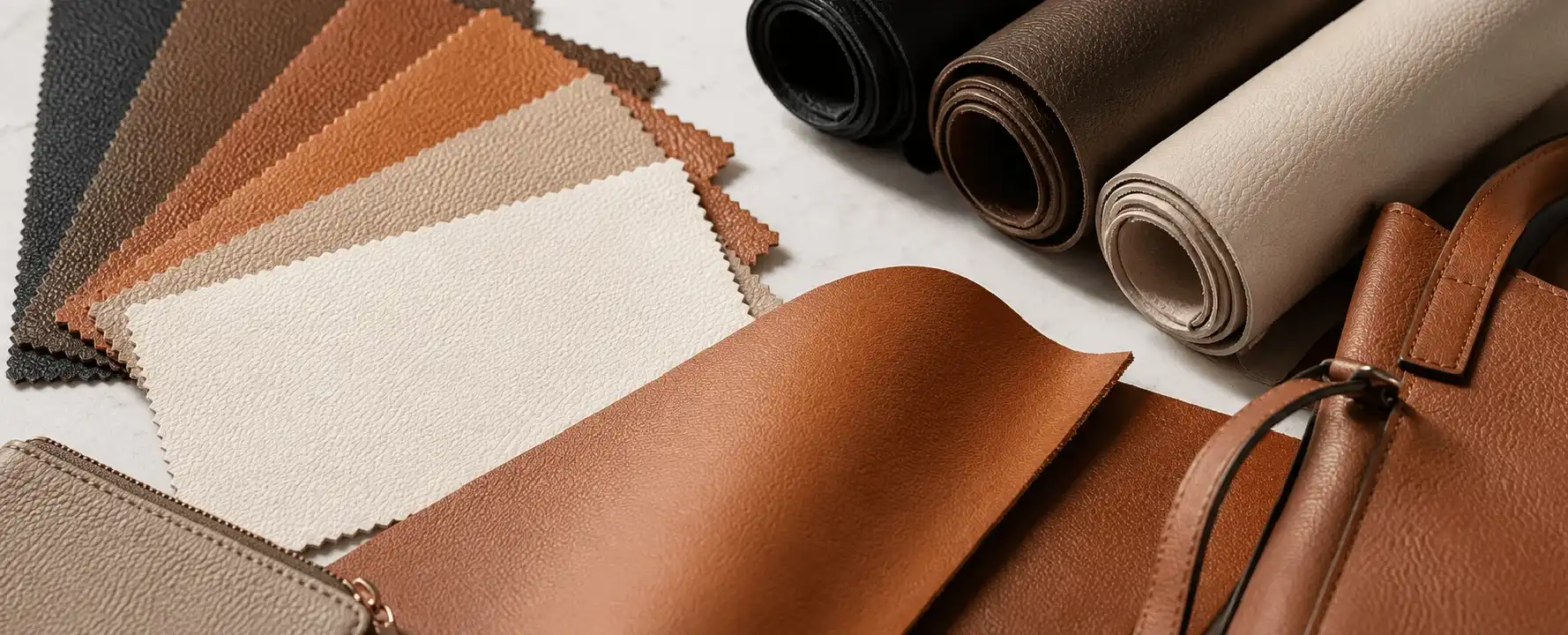
PU leather stands for polyurethane leather. It is a synthetic leather-like material made by coating a fabric backing with a layer of polyurethane resin. It is used to imitate animal leather without using animal hides. It is a bonded plastic fabric that imitates the grain, texture, and feel of real leather.
That definition will suffice on its own, but if you are a brand owner, importer, or wholesale buyer deciding whether to build a product line with PU leather, you need more than a definition. This is a material where the construction, the grade of a given roll, the claims a supplier should be able to back up, and the end use of the product all determine whether PU leather protects your margins or hurts your returns. This guide covers all of it.

Every roll of PU leather starts with a backing fabric. This backing can be polyester, nylon, cotton, or a knitted blend, depending on the strength and flexibility the end product needs. The backing fabric is then coated with polyurethane resin in one of two ways.
Dry process (coating method): the resin is applied and cured over the backing fabric in a heat chamber. This method is used in most low- to mid-range PU leathers because it is cheaper and faster. It produces a more uniform surface, but also a more plastic-like one.
Wet process (coagulation method): PU resin is impregnated into the fabric, then passed through a coagulation bath, forming a microporous structure on the surface. This method produces a result closer to the breathability and feel of genuine leather, and it costs more to produce. Wet-process PU leather is the right choice for brands that want a softer hand-feel and better long-term flexibility.
After coating, the surface is embossed with a grain pattern (pebble grain, saffiano, crocodile, smooth napa), then finished with additional coats for scratch resistance, gloss control, and color.
The base material and the process used are the two biggest factors behind the quality gap between a $2/yard PU leather and an $8/yard PU leather. If your supplier can’t tell you which process is used and what backing fabric is in your roll, that’s a reason to be skeptical before placing an order.
Buyers often lump these into one category, but they are not the same, and failing to differentiate them in a sourcing brief will cost you money.
| Factor | Genuine Leather | PU Leather | PVC (Vinyl) Leather | Microfiber Leather |
|---|---|---|---|---|
| Material | Animal hide | Polyurethane on fabric | Polyvinyl chloride on fabric | Polyurethane on ultra-fine microfiber base |
| Typical lifespan | 10-20 years with care | 2-5 years | 3-6 years | 5-8 years |
| Cost vs. genuine leather | Baseline | 1/3 to 1/5 the cost | Lowest cost | Mid-range, above PU |
| Breathability | High | Low to moderate | Very low | Moderate to good |
| Feel | Warm, natural grain, ages with patina | Cooler, uniform grain, does not patina | Plastic, stiff at low temps | Closest synthetic match to real leather |
| Best for | Premium, long-life goods | Fashion-forward, seasonal, budget-conscious lines | Very low-cost, high-volume items | Mid-to-premium synthetic lines |
| Environmental note | Biodegradable material, but tanning has heavy water/chemical use | Petroleum-based, not biodegradable | Petroleum-based, releases dioxins in production | Petroleum-based, not biodegradable |
From a sourcing perspective, PU leather isn’t a downgrade from leather — it’s a different material for a different purpose. Choose PU leather when your brand needs design flexibility, consistent color and texture across a large run, and a lower cost. Marketing it as a long-life, heirloom-quality material is misleading: PU leather will wear out well before genuine leather shows comparable wear.

Two suppliers can both call their material “PU leather” and hand you products with completely different lifespans. Quality varies enormously within this category, and price alone won’t tell you where a sample falls. Here’s what actually separates the grades.
Backing fabric quality. A tightly woven, high-denier polyester or cotton backing holds the coating better and resists stretching. Cheap backings show through the coating over time and lead to cracking at stress points.
Coating thickness and consistency. Premium PU leather holds a tight thickness tolerance across the full width of the roll. Inconsistent thickness means inconsistent durability within the same batch — some units in your order will fail before others.
Resin quality. Higher-grade PU resins resist hydrolysis (breakdown from humidity and heat) far longer. This is the single biggest factor in whether your product lasts two years or five.
Finishing layer. A proper top-coat finish resists scuffing and color transfer. Cheap PU leather uses a minimal or absent finishing coat, so color rubs off within months.
You can check basic quality yourself with four simple tests before committing to a bulk order:

When placing a private label or OEM order of any real volume, don’t accept “good quality” as an answer. Ask for the specific numbers, backed by a lab test report — not a verbal assurance. These are the benchmarks that separate a serious manufacturer from someone reselling an unknown roll:
Any manufacturer supplying Western wholesale and retail markets at real volume should be able to produce these figures from a third-party lab, not an internal spec sheet. If a supplier can’t produce a test report on request, treat every other claim they make with the same skepticism.

This is where a lot of buyers get burned after the product has already landed. Clearing customs is not the same as being compliant for retail sale.
REACH (EU): Restricts hazardous substances, including SVHC (Substances of Very High Concern). Additives, flame retardants, and pigments used in the coating must be checked against the restricted substances list before the product enters the EU market.
RoHS: Limits harmful substances such as lead and cadmium — relevant for any PU leather product with metal hardware or trims.
California Proposition 65 (US): May require a warning label, but the more practical route is a formulation that avoids the listed chemicals entirely, so no warning is needed at all.
OEKO-TEX Standard 100: Third-party safety testing for harmful chemicals, widely requested by retail buyers in apparel and accessories categories.
ISO 9001: Not a product safety certification, but proof the factory runs a standardized, traceable production process — which matters for consistency across repeat orders.
Ask for compliance documentation tied to the specific SKU and colorway you’re ordering, not a generic factory certificate. Dye lots and additive batches vary between production runs, and one old test report doesn’t cover every color and texture combination you might order later.

PU leather is versatile, but the right grade changes by product category:
If a manufacturer tells you the same PU leather grade works for a wallet and a sofa, they either don’t understand the material or aren’t being straight with you. Formulation, thickness, and coating should change with end use.

PU leather typically costs one-third to one-fifth of genuine leather per unit of material, and lasts two to five years under normal use, compared to ten to twenty years for genuine leather with care. Microfiber leather sits in between: better durability than standard PU (five to eight years) while keeping most of the cost advantage over genuine leather.
This isn’t a case of one material being objectively better — it’s a total cost of ownership question, and the right answer depends on your business model:

Confirm the following before committing to a supplier for a private label or OEM run. This is what separates a manufacturing partner from a middleman reselling unverified stock:
If a supplier can’t answer more than one or two of these clearly, keep looking. The material cost difference between suppliers is usually small. The cost of a failed compliance test, a returns spike from delamination, or a blown production timeline is not.

Approving a sample that isn’t from production stock. Suppliers sometimes send a hand-picked sample to win the order, then ship a different batch for the bulk run. Require that your approved sample be pulled from the same lot number as the production run, confirmed in writing before payment.
Skipping the climate match. A PU leather grade that performs fine in a dry, moderate climate can crack or stiffen fast in a hot, humid market or a cold one. If you sell into multiple regions, ask for hydrolysis and flex test data at the temperature and humidity range your customers actually live in, not just standard lab conditions.
Assuming one grade fits every product in the line. A wallet, a belt, and a tote bag put different mechanical stress on the same material. Buyers who order one PU spec for an entire catalog often see belts or footwear fail long before bags do, because those categories needed a higher flex and abrasion rating from the start.
Not re-testing after a color or texture change. Compliance reports are tied to a specific formulation. A new color often means a new pigment or additive package, which can change hydrolysis or REACH results. A report from six months ago on a different color doesn’t cover your new order.
Negotiating price without asking about resin type. Two quotes that look similar on price can use completely different formulations. Solvent-based resin is usually cheaper and carries a higher VOC and compliance risk. Water-based or solvent-free PU costs more but lowers both compliance risk and the odds of a chemical smell reaching the customer. Price alone isn’t a fair comparison unless the resin type is the same.
Placing a large first order without a pilot run. Especially with a new supplier or a new grade, a smaller pilot order lets you verify real-world performance and consistency before committing to full volume. A pilot run costs far less than a full container of product that doesn’t hold up.
It depends on the grade. Premium PU leather with proper backing fabric, tight coating tolerances, and hydrolysis-resistant resin can last two to five years of normal use. Low-grade PU leather can start peeling within months. The label “PU leather” alone tells you nothing about which one you’re getting.
PU leather with a synthetic backing (polyester, cotton, nylon) is vegan. Some PU leather uses a split leather backing (an animal hide by-product, also called bicast leather), which is not vegan even though it’s often marketed the same way. Ask your supplier which backing your material uses if vegan certification matters to your brand.
Standard PU leather lasts two to five years under normal use. Higher-grade formulations with strong hydrolysis resistance and quality backing fabric can extend that range. Microfiber leather, a step up in the synthetic category, typically lasts five to eight years.
Not inherently, but low-quality PU leather made with excess plasticizers or solvent-based resins can emit VOCs and fail REACH or OEKO-TEX testing. Water-based or solvent-free formulations carry lower risk. Always request current compliance reports for the specific product and colorway you’re sourcing.
No. PU leather is a petroleum-based plastic and does not biodegrade. It’s also difficult to recycle through standard textile streams, since the fabric backing and polyurethane coating are bonded together. If sustainability messaging is part of your brand positioning, this is a limitation to plan around rather than gloss over.
“Vegan leather” is a marketing term, not a material spec. It can refer to PU leather, PVC leather, microfiber leather, or newer plant-based alternatives (cactus, mushroom, or pineapple fiber). When a supplier says “vegan leather,” ask them to specify the actual material and construction.
Standard PU leather becomes stiffer and more prone to cracking in cold temperatures because the polymer loses flexibility. If your product ships to colder climates, ask for flex resistance results at low temperature specifically (Bally flex cycles at around -10°C), not just room-temperature figures.

PU leather is a legitimate, widely used material across bags, wallets, belts, footwear, apparel, and upholstery, and it makes commercial sense for a large share of product lines. The mistake isn’t choosing PU leather over genuine leather — it’s assuming all PU leather is the same and skipping the technical verification that separates a two-year product from a five-year one. Match the grade to the product’s end use, get the lab reports before committing to volume, and confirm compliance documentation for the exact SKU and colorway you’re ordering, not a generic factory certificate.
Surafh Industry works with private label and OEM buyers across the US, Canada, UK, EU, and Australia on both genuine leather and PU leather product lines, and can supply lab-backed test reports, compliance documentation, and matched-grade material recommendations by product category before you commit to a production run.